Hotel Pre-Arrival Engagement Strategies to Protect Profit Margins


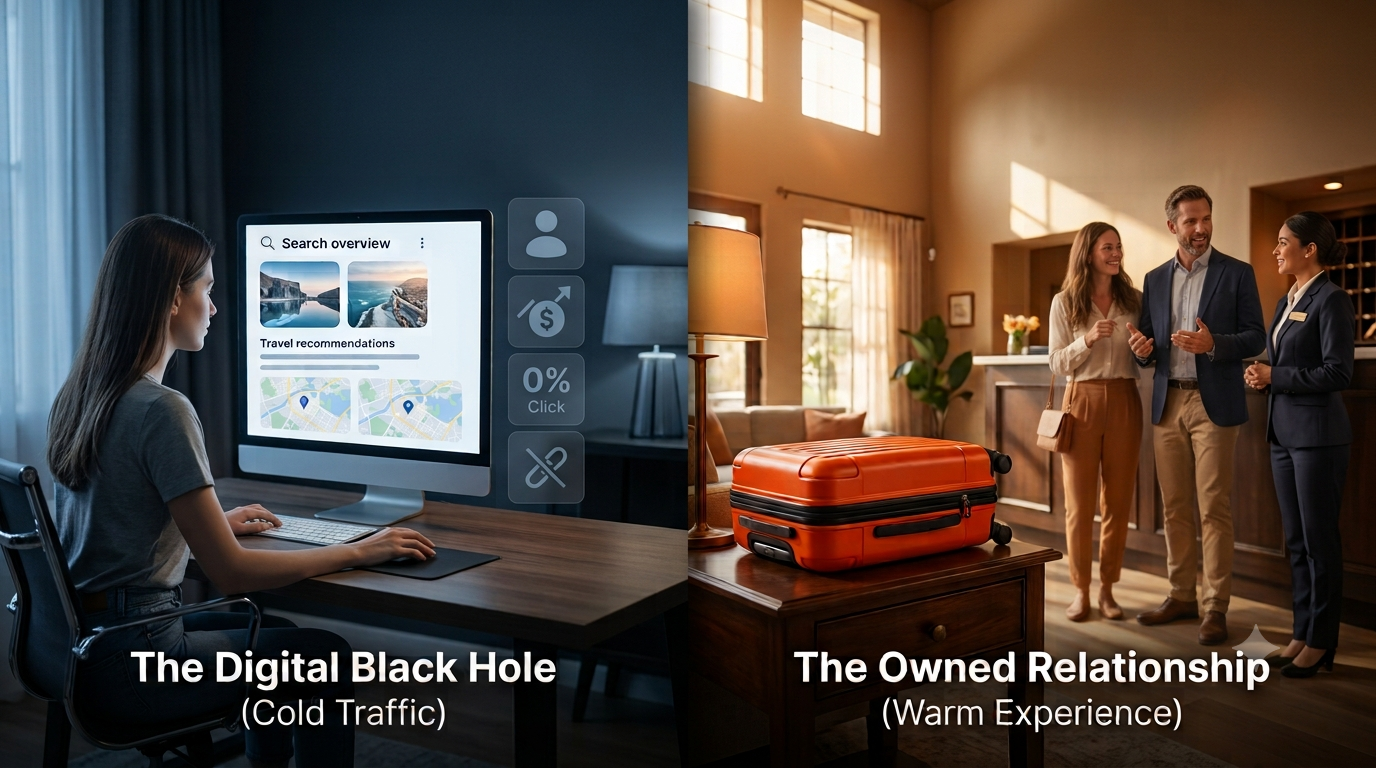
The Black Hole of Guest Engagement: Winning the Pre-Arrival Window
Guests aren't being indecisive in the weeks before their trip — they're protecting their two most valuable assets. Here's why that matters for your bottom line, and how hotels can show up for it.
TL;DR
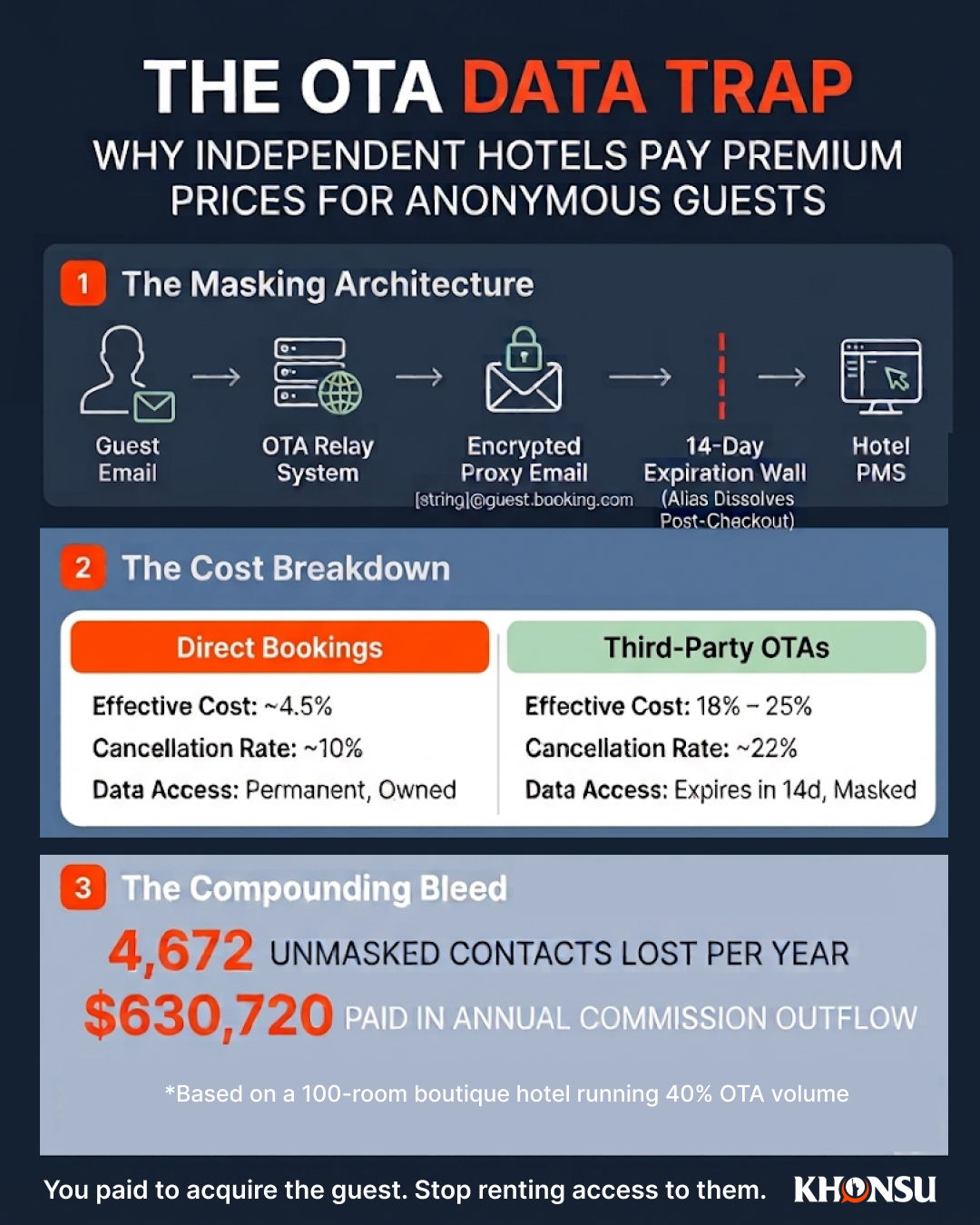
Forcing your front desk agents to collect guest emails at check-in is an operational trap. By the time a traveler steps up to your desk, the high-value pre-arrival planning window has already closed—meaning the OTA has already controlled the entire relationship, dictated their itinerary, and pocketed the commission. True direct-booking momentum isn't built by interrogating tired guests for their email while a check-in line backs up into the lobby; it’s won weeks earlier by delivering undeniable utility when they are actively planning their trip. Khonsu unmasks guest emails pre-arrival without adding apps or front-desk labor, capturing the direct relationship before the proxy wall ever goes up.
{{ad-three}}
Protecting a hotel's profitability is an ongoing war of attrition.
You can maximize your occupancy and hit your average daily rate (ADR) targets, but the real story is told on the P&L statement — where rising marketing budgets, fixed operational costs, and compounding OTA commissions quietly erode your margins before the cash ever hits the bank.
That is why capturing direct guest data before arrival — often called 'guest unmasking' — is one of the most effective strategies for direct hotel bookings. Reducing customer acquisition costs through organic channels isn't just a trendy marketing tactic; it is the most reliable way to reduce OTA commission costs permanently.
They are direct, necessary tools for protecting margin and choking out OTA dependency.
While unmasking anonymous guests and lowering acquisition costs might seem like entirely separate strategies, they tie together flawlessly when you map out the traveler's actual journey. The moment a room is locked in, a specific behavioral window opens up — one most hotels never enter, and one where every action a guest takes is an opportunity sitting in plain sight.
The Black Hole of Guest Engagement
Picture two guests who both just booked a 5-night stay at your property.
One is celebrating a 10th anniversary. The other is squeezing in a long weekend between work trips, with 3 days to see as much of the city as possible.
They will research differently. They will budget differently. They will build entirely different days. But underneath the differences, they are protecting the exact same two things: time and money.
Between the moment a guest clicks "book" and the moment they walk through your lobby doors, there is a massive window of high-intent activity. Guests are spending hours trying to protect their time and their budget.
Right now, most hotels treat this pre-arrival window as dead air. But from a hospitality and revenue perspective, this is your golden window — the chance to capture the relationship before third-party platforms or local competitors intercept your guest entirely.
Hotels care about proactive guest relationships for a simple reason: a guest who plans their trip with the hotel before they arrive is a guest who is already locked into that hotel's ecosystem. They are less likely to cancel, more likely to spend on-property, and far easier for the front desk to manage.
Understanding what's happening inside that window — guest by guest, decision by decision — is what separates hotels that capture this value from hotels that watch it pass by.

The Wish List: From Blind Reservation to Rich Guest Profile
The planning process almost always starts the same way: a list.
Sometimes it's a note on a phone. Sometimes it's a folder of Instagram saves. Sometimes it's barely a list at all — just a vague sense of "we want to see something iconic" or "we need one really good meal."
What goes on that list depends entirely on why the trip is happening:
* The celebrating couple is looking for something memorable, maybe romantic, maybe a splurge they wouldn't normally justify.
* The family with young kids is filtering for activities that won't end in a meltdown by 2 PM.
* The business traveler tacking on a personal day wants maximum experience packed into minimum time.
* The solo traveler chasing a bucket list item has one non-negotiable activity and total flexibility around everything else.
When a hotel sends a generic, static "Top 10" PDF, it treats the celebrating couple, the stressed business traveler, and the family with toddlers exactly the same. It signals — even unintentionally — that the property isn't actually paying attention.
This is the operational blind spot. A proactive tool that lets the guest build their own contextual itinerary does more than make the guest feel understood. It transforms a blind reservation into a rich guest profile. Your front desk knows exactly who is arriving and why, before the guest ever checks in.
Location and Logistics: Intercepting Anxiety Before It Hits Your Lobby
Once the wish list starts taking shape, guests start evaluating their hotel against it. Nobody wants to lose an hour of their trip commuting back and forth to a property that's disconnected from where they actually want to be.
As the arrival date nears, this anxiety spikes: How do I get there? How close am I to everything on my list?
If a hotel stays reactive, that anxiety lands squarely on your understaffed front desk. Your frontline team is already stretched incredibly thin by industry-wide labor shortages. Forcing them to act as manual data collectors, baggage coordinators, and neighborhood tour guides while processing physical room keys is a recipe for staff burnout and massive line bottlenecks.
A hotel that proactively anchors a guest's custom itinerary to its own physical location does three things at once:
- It eliminates travel anxiety before it forms.
- It proves the property's structural value without saying a word about it.
- It deflects front-desk friction and logistical layout questions before they ever reach the lobby.
Food: The Battle for Local Authority
For a meaningful share of travelers, the meals are not incidental to the trip. They are the trip. Guests are scrolling food accounts, cross-referencing reviews, and building dining lists with the same seriousness they apply to major attractions.
If a hotel leaves guests to search blindly across Yelp and TikTok, it loses control of the narrative entirely — and loses the guest's wallet to whatever restaurant happened to win the algorithm that day.
A proactive platform lets the hotel step in as the trusted local expert instead. By curating dining recommendations early in the guest's own planning process, the hotel doesn't just solve a research headache. It guides guests toward on-property dining, the lobby bar, and preferred partners — keeping spend inside the hotel's own ecosystem instead of leaking out to a restaurant three neighborhoods away.
Budget: Where Unmasked Data and Increased Spend Meet
Underneath the wish list, the location preference, and the dining research sits a harder, less flexible question: how much is all of this going to cost, and can we actually afford to do everything on our list?
When guests try to piece together attraction costs and passes on their own, they get frustrated and frequently give up halfway through, settling for guesswork instead of a real answer.
Here's the opportunity hidden inside that frustration: when a hotel provides a tool that helps guests confidently calculate and save on local attractions, a meaningful shift occurs. Guests don't pocket those savings — they reallocate them.
A guest who saves $50 to $100 on local passes is a guest who now has room in their budget to upgrade their room layout, book a treatment at the spa, or buy a round of drinks at your hotel bar.
And critically, guests will happily provide their real email address and booking reference to unlock those savings. That's the exact first-party data OTAs have been blocking, handed over willingly because the hotel gave undeniable utility first.
{{ad-one}}
What This Means for Your Bottom Line
This entire planning process — the wish lists, the dining research, the budget mapping — is happening right now across Reddit threads, group chats, and a dozen open browser tabs. It's happening completely outside your hotel's view, with your brand offering zero help.
By introducing a branded, state-saving Trip Planner during this exact pre-arrival window, you shift your hotel from a reactive place to sleep into a proactive partner in the guest's entire experience.
You aren't forcing an intrusive marketing pop-up on a guest who doesn't want it. You're offering an indispensable operational utility. For the guest, it's a way to streamline their trip. But for the hotelier, it is the ultimate aspirin for your margin headache.
The guest arrives confident, organized, and already loyal to a property that solved their logistical headaches before they ever checked in. And the hotel walks away with verified, direct guest data, reduced front-desk friction, lower reliance on paid acquisition, and a guest relationship that no OTA had any part in building.
To see how this impacts a hotel's P&L, read this next.
See How Khonsu Turns the Pre-Arrival Window Into Guest Data and Revenue
Khonsu's white-labeled Trip Planner gives guests a single place to organize their wish list, discover curated local recommendations, and build a day-by-day plan — while giving your hotel the direct guest data, on-property revenue lift, and reduced OTA dependency that come from showing up first.
Ready to see how Khonsu unmasks anonymous OTA guests?

We'll Be In Touch Within 24 Hours
.png)