How to Reduce OTA Commission Costs for Independent Hotels

The Invisible Bleed: How Independent Hotels Lose Guest Data Before Check-In
Most independent hotels never receive a single real email address from their OTA-booked guests. Here's the mechanism behind it, what it actually costs, and how to fix it before the next booking.
TL;DR
Every guest who books through an OTA gets a temporary, encrypted proxy email instead of their real address — and that proxy expires 14 days after checkout, permanently severing the hotel's ability to reach them. Combined with commission rates of 18–25% and a cancellation rate nearly double that of direct bookings, this masking architecture means independent hotels are paying premium prices to acquire the least loyal, least retainable guests in their entire mix. A 100-room hotel running 40% OTA volume can lose direct contact with over 4,600 guests a year — and pay full commission again to re-acquire the same traveler on their next visit. The fix starts with a clear plan to unmask guest emails and reduce OTA dependency: Khonsu's pre-arrival Trip Planner gives guests a reason to hand over their real email before the proxy wall ever goes up.
{{ad-three}}
The Masking Mechanism: The Silent Erasure of Your Guest Database
Most independent hotel operators know that online travel agencies charge a premium commission on every booking. Far fewer look closely at the second, quieter toll taken on their business: the systematic masking of the guest's digital identity.
When a traveler books your property through a major third-party platform, you aren't just outsourcing the transaction. You're outsourcing the relationship. The moment the booking is processed, the platform's routing engine intercepts the guest's real email address and replaces it with an encrypted, temporary proxy.
Look in your Property Management System after an OTA booking comes through, and you won't find a personal or corporate email address. You'll find a randomized, platform-controlled domain string:
* Booking.com: [random-string]@guest.booking.com
* Expedia Group: [random-string]@expediapartnercentral.com
This isn't a formatting quirk. It's an engineered, expiring proxy architecture built specifically to keep the hotel out of direct communication with its own guest.
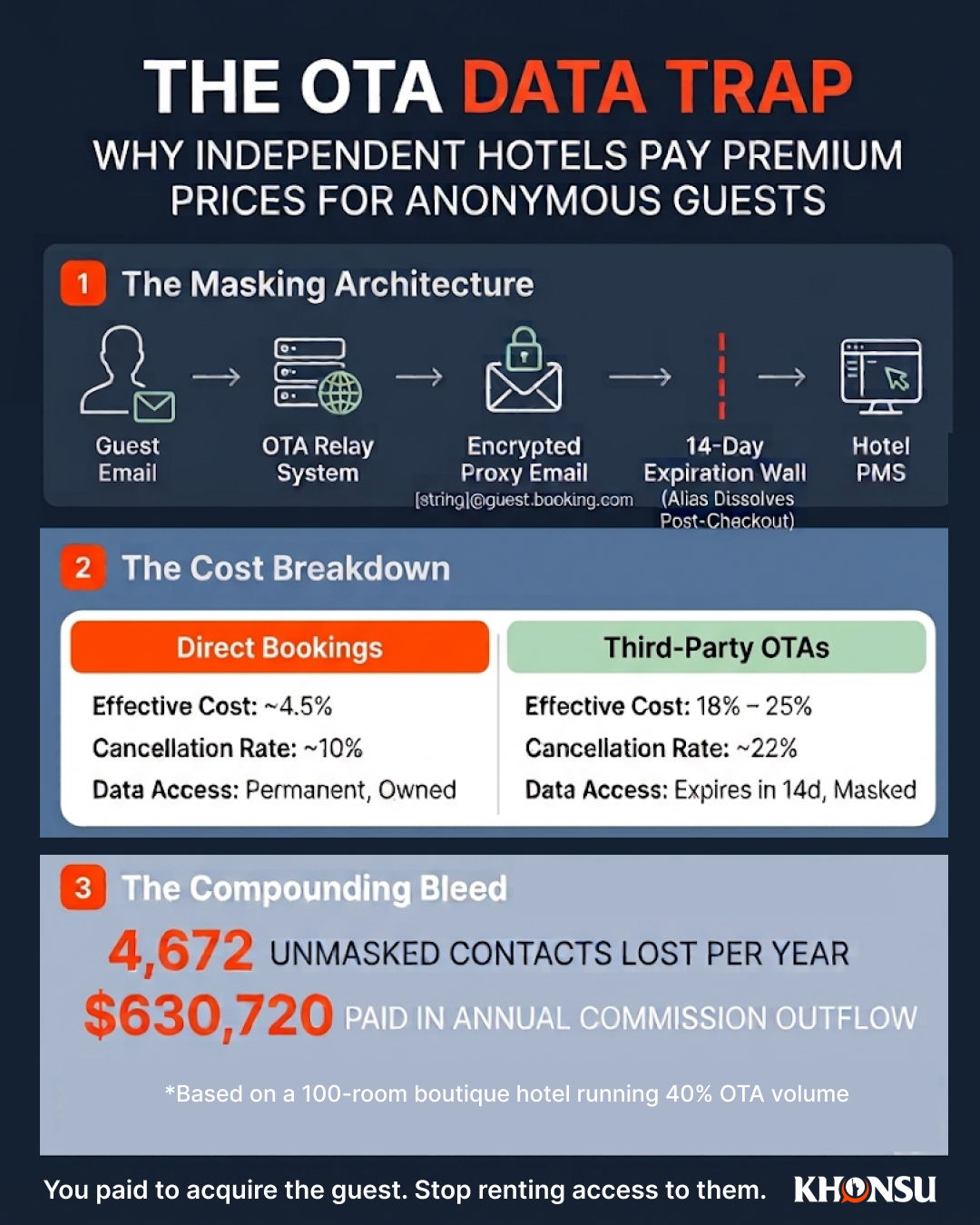
Guest Real Email ──> OTA Relay System ──> [Encrypted Proxy Email] ──> Hotel PMS
│
(14-Day Expiration Wall)
These aliases operate under a strict, platform-enforced 14-day expiration window that triggers automatically after departure. Try to message that address fifteen days post-checkout and the communication hits a dead end. The alias has dissolved. The message bounces or simply vanishes.
The proxy isn't a passive forwarder, either. These platforms actively run filtering scripts on incoming messages. A pre-arrival email sent through the proxy that contains certain hyperlinks, external URLs, or tracking scripts — like a link to an external trip-planning tool — frequently gets stripped or blocked entirely before it reaches the guest.
The position this puts hotels in is stark. You've funded the labor to clean the room, staff the desk, and deliver a flawless physical stay. But the digital asset — the clean, unmasked profile that would let you market to that traveler for the next decade — stays locked inside someone else's ecosystem. You paid for the acquisition. You're structurally barred from owning the contact.
{{ad-one}}
The Stakes: Quantifying the Real Cost of Anonymous Guests
To understand why losing the direct guest relationship matters, you have to look past occupancy and focus entirely on net revenue efficiency. When a third-party platform controls the communication loop, the financial erosion hits in three distinct waves.
The True Acquisition Tax
Booking.com's standard commission rate sits between 15% and 18% depending on property type and participation level. To stay visible against larger competitors, independent hotels are frequently pushed into secondary visibility programs — Booking.com's Genius or Preferred Partner tiers, or Expedia's equivalent accelerators — which carry their own cost. Properties in competitive markets are commonly paying an effective 22% to 25% once these programs are factored in.
There's a hidden mechanic inside the Genius programme worth understanding specifically: the headline commission rate doesn't actually rise. Instead, the hotel funds the guest discount itself. A 10% Genius discount stacked on a 15% commission means the property nets roughly 23.5% less than its listed rate — even though the commission line item still reads 15%.
Compare that to a direct booking on a hotel's own engine, where total technical and merchant processing overhead typically runs around 4.5%. Writing a check for 18 to 25% to an intermediary — when the direct alternative costs a fraction of that — is a structural tax most independent hotels are paying without fully pricing it into their decision-making.
The Ghost Backlog: Paying Premium for Volatile Inventory
The financial cost of an anonymous booking runs deeper than commission. OTA reservations cancel at roughly double the rate of direct bookings. Direct channels maintain a cancellation rate around 10.6%, while third-party platforms run a global average closer to 21.8% — a figure that spikes well above 40% on flexible, peak-season rate plans.
Major OTA apps are built to encourage exactly this behavior. "Risk-free booking" messaging actively prompts travelers to hold three or four competing properties for the same weekend while they make up their minds. For the hotel, this creates a chaotic backlog of premium inventory held for guests who are treating the reservation as a placeholder rather than a commitment. When those speculative bookings dissolve days before arrival, the hotel is forced into a defensive scramble — slashing rates, tanking its own ADR targets, and racing to backfill rooms it thought were sold.
Distribution Metric
Direct Channels
Third-Party OTAs
Effective Acquisition Cost
~4.5%
18% – 25%
Average Cancellation Rate
~10.6%
~21.8%
Guest Data Access
Full, permanent ownership
Masked proxy, 14-day expiration
The Lifetime Value Chasm
The deepest cost of the masked email architecture is what it does to guest lifetime value.
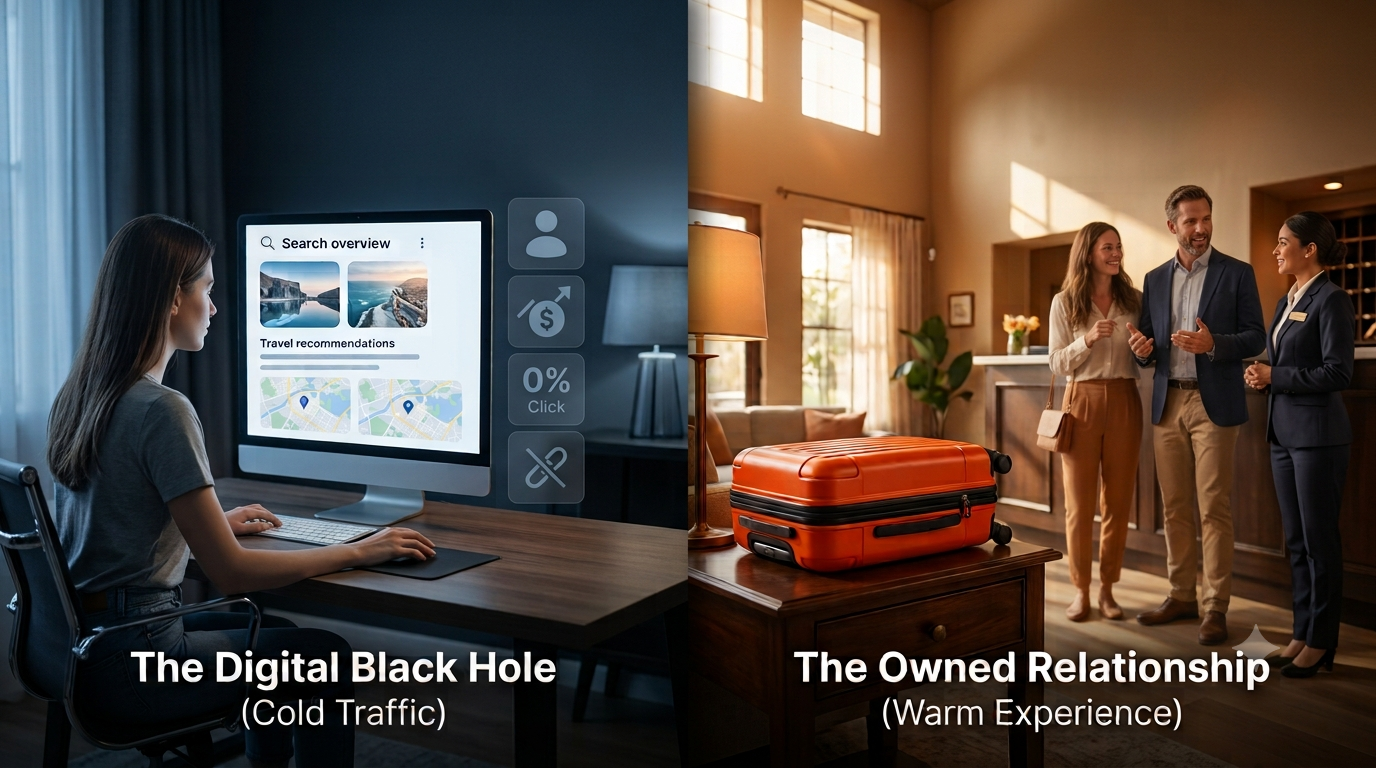
In a direct relationship, the first booking is just an entry point. Once a hotel owns a clean, unmasked email, that guest enters a loyalty funnel — off-season promotions, targeted campaigns, direct-booking incentives — that compounds in value over a decade. When the email is masked, that loop never opens.
A guest can have a flawless stay, leave thrilled, and still be invisible to the hotel two years later when they plan a return trip. With no direct line to that guest, they open the OTA app, search the area, and click "book again." The hotel pays full acquisition cost — often north of 20% — for a guest it already earned, housed, and served years earlier.
Independent properties are consistently paying the highest distribution costs to acquire the most volatile, least loyal travelers in their entire guest mix. Shifting that requires moving guests from anonymous platform data into verified, owned relationships before they ever reach the front desk.
A Realistic Model: What the Bleed Looks Like for a 100-Room Hotel
To see how these percentages translate into real numbers, consider a typical independent boutique hotel — 100 rooms, running at 80% annual occupancy with a $300 average daily rate. That's 29,200 occupied room nights a year, or roughly $8.76 million in annual rooms revenue.
If 40% of that inventory books through third-party OTAs, that's 11,680 room nights a year flowing through Expedia and Booking.com. At a blended effective commission rate of 18% — accounting for baseline visibility programs — that property is paying approximately $630,720 a year in pure commission:
11,680 OTA Room Nights × $300 ADR × 18% Commission = $630,720 Annual Outflow
The damage doesn't stop at commission. Assuming an average stay of 2.5 nights, those 11,680 room nights represent roughly 4,672 individual travel parties checking in each year. Because of the expiring proxy architecture, this hotel loses the direct digital identity of 4,672 high-intent travelers annually — unless it deploys a proactive mechanism to unmask those guests during the pre-arrival window.
Over three years, that's more than 14,000 guests who stayed, were served well, and left the property with zero technical ability to ever email, remarket, or invite them back directly.
{{ad-two}}
Why It Compounds: The Trap of Recurring Acquisition Costs
Losing a single guest's email might feel like a minor, unavoidable cost of doing business with OTAs. It isn't. It's a structural defect that compounds, turning a one-time marketing cost into a permanent, recurring drain.
In most business models, customer acquisition cost is front-loaded — pay a premium once, then enjoy high-margin repeat business for years. The anonymous OTA model flips that. Because the proxy email dissolves 14 days after checkout, the hotel is trapped re-acquiring the exact same guest, at full price, every time they return.
Year 1: Pay ~20% OTA Tax ──> Flawless Stay ──> Email Proxy Expires
│
▼
Year 3: Pay ~20% OTA Tax <── Guest Books Again Via App <── Traveler Wants to Return
A traveler books three nights for $900, generating a $180 commission at 20%. They stay, love it, check out. The proxy dissolves. Two years later they want to return — but with no direct relationship and no loyalty login sitting in their inbox, they default to the same OTA app that brought them the first time. The hotel writes another $180 commission check for a guest whose loyalty it already earned and paid for once.
Over a three-year horizon, a hotel that routinely lets 40% of its guests slip behind encrypted proxies isn't building a compounding base of direct advocates that lowers acquisition costs over time. It's funding a permanent subscription to rent access to its own repeat business.
Closing the Gap Before the Proxy Wall Goes Up
The 14-day expiration window only matters if a hotel waits until checkout to try to capture a guest's real email. The fix isn't competing with the proxy after the fact — it's capturing the relationship before the proxy ever becomes the only contact on file.
This is the exact problem Khonsu's pre-arrival Trip Planner is built to solve. By giving guests a reason to voluntarily provide their real email — saving a personalized itinerary they built themselves — hotels unmask the guest relationship during the pre-arrival window, while the trip is still being planned and long before any 14-day wall has a chance to close. The email captured isn't the masked proxy. It's the guest's actual address, freely given in exchange for something they wanted.
You can deliver five-star hospitality on-site and still lose the guest the moment they walk out the door, if you never captured a way to reach them again. Moving the needle on profitability means capturing that relationship before the guest ever reaches your lobby — not trying to recover it after they've already left.
See how Khonsu unmasks the guest relationship before check-in.
Commission rates, cancellation data, and Net RevPAR figures referenced in this article are sourced from industry analysis published by Webb Marketing and Rield Revenue Management. The 100-room hotel example above is an illustrative model and does not represent the data of any specific property.

We'll Be In Touch Within 24 Hours
.png)